Tầng 8, Tòa nhà Sannam, số 78 Phố Duy Tân, P.Dịch Vọng Hậu, Q. Cầu Giấy, Tp. Hà Nội, Việt Nam

Advisory
Direct: 0904565626

Products of Tri Viet

Direct Digital Controller (DDC)

Operating technical systems in buildings requires precise and synchronized control across multiple devices. The Direct Digital Controller (DDC) serves as a central solution, enabling data collection, signal processing, and automated control of systems such as HVAC, lighting, and pumps—thereby enhancing management efficiency and optimizing overall operations.

Overview of Direct Digital Controllers (DDC)

A Direct Digital Controller (DDC) is an automation device used in Building Management Systems (BMS). Its primary function is to receive data from sensors and control technical equipment based on pre-programmed logic.

Unlike traditional control methods, digital DDC controllers process data in real time, ensuring more accurate, flexible, and energy-efficient system operation.

Why BMS Requires DDC Controllers

For a BMS to operate effectively, a field-level control layer is essential to ensure fast response and precise processing. The DDC controller fulfills this role by acting as a bridge between physical devices and the central management system:

- Local data acquisition and processing: DDC controllers receive signals from sensors (temperature, humidity, pressure, flow, etc.) and process them based on programmed logic without fully relying on the central system.

- Real-time device control: Directly controls systems such as HVAC, lighting, pumps, and fans with minimal latency, ensuring rapid response to real operating conditions.

- Integration with BMS: Acts as a communication bridge, sending data to the central BMS for monitoring while receiving control commands when needed.

- Reduced central system load: By handling local processing, DDC controllers reduce the burden on BMS servers, improving system stability and minimizing risks during network failures.

- Operational optimization and energy savings: Enables intelligent control scenarios, reducing energy consumption and limiting manual intervention.

With these roles, DDC controllers become a core component for maintaining stable, flexible, and efficient building operations.

Key Functions of DDC Controllers

To meet the demands of building automation, DDC controllers are designed with several critical functions:

- Input signal processing: Collects data from field devices and sensors, then converts and processes it using control algorithms.

- Precise output control: Sends control signals to actuators such as valves, fans, pumps, and dampers for accurate system response.

- Flexible programming and automation: Supports scheduling, time-based control, and condition-based logic to optimize performance and energy usage.

- Communication and integration: Supports protocols such as BACnet and Modbus, enabling seamless integration with BMS platforms.

- Monitoring and fault detection: Continuously monitors system status, detects abnormalities, and sends timely alerts.

- Data logging and retrieval: Stores operational data for analysis and long-term system optimization.

These functions ensure stable operation while enhancing control and optimization capabilities in modern buildings.

Applications of DDC Controllers in Building Systems

DDC controllers are widely deployed across various technical systems to ensure synchronized and precise automation:

- HVAC systems: The most critical application, controlling temperature, humidity, airflow, and optimizing chiller, AHU, and FCU performance.

- Lighting systems: Enables automated on/off control and dimming based on schedules or sensor input, improving energy efficiency and user experience.

- Water supply and drainage systems: Controls pump operations based on pressure or flow, ensuring stable water supply and reduced energy consumption.

- Integrated BMS platforms: Acts as a core interface connecting subsystems, transmitting data to the central system for monitoring and control.

Thanks to real-time processing and flexible integration, DDC controllers are widely used in offices, hotels, shopping malls, and industrial facilities.

Criteria for Selecting the Right DDC Controller

Choosing the right DDC controller requires evaluating both technical specifications and operational needs:

- Scalability and I/O configuration: Should support expandable I/O modules to match system size and future upgrades.

- Standard communication protocols: Prefer devices supporting BACnet, Modbus, TCP/IP for seamless integration.

- Reliability and durability: Must operate continuously (24/7), with resistance to interference and environmental conditions.

- Flexible programming capability: Allows customized control logic, scheduling, and condition-based automation.

- System compatibility: Ensures smooth integration with existing BMS infrastructure, reducing deployment costs.

- Technical support and supplier expertise: Choose providers with proven experience and strong after-sales support.

Selecting the right DDC controller ensures system stability, scalability, and long-term cost efficiency.

Tri Viet Controls – Supplier of Digital DDC Controllers

Choosing a reliable supplier directly impacts the performance of DDC controllers in building systems. Tri Viet Controls (trivicontrols.com) specializes in building automation and provides integrated BMS solutions:

- Professional expertise: Engineering team with strong knowledge in BMS and automation systems.

- Comprehensive product range: Offers a variety of digital DDC controllers and related devices for different system scales.

 -Implementation capability: Experience in deploying solutions for buildings, data centers, and technical facilities.

- Technical support: Provides tailored solutions and ongoing maintenance support after installation.

- Partnering with a trusted provider like Tri Viet Controls ensures optimal performance, system stability, and scalability.
Digital DDC controllers are essential solutions for automating and optimizing modern building systems. With real-time data processing, flexible control, and seamless BMS integration, they enhance management efficiency, reduce energy consumption, and ensure stable long-term operation.

BỘ ĐIỀU KHIỂN DDC DX9100   – JOHNSON CONTROLS

BỘ ĐIỀU KHIỂN DDC DX9100 – JOHNSON CONTROLS

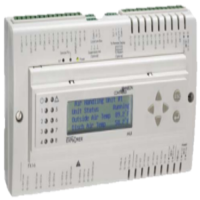
The DX-9100 Extended Digital Controller is the ideal digital control solution for multiple 
chiller or boiler plant applications, air handling units, or distributed lighting control. As a standalone controller, the DX-9100 provides a real-time clock, extendable I/O, and graphic software programming to target a variety of applications. Individual point monitoring and control is available through the front panel LED displaysequences
Model Number :
DX-9100-8454 , DT-9100-8104 

BỘ ĐIỀU KHIỂN DDC FX07   – JOHNSON CONTROLS

BỘ ĐIỀU KHIỂN DDC FX07 – JOHNSON CONTROLS

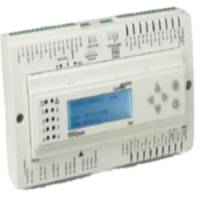
The controller has 17 physical inputs and outputs and supports a wide range of temperature sensors and actuating devices. Active sensors for the measurement of humidity, pressure, and other variables are also supported. The FX07 also includes an onboard real-time clock to support the start-stop scheduling of equipment and real-time based control 
sequences.

Model Number :
LP-FX07D00-000C , LP-FX07D01-000C 

BỘ ĐIỀU KHIỂN DDC FX06   – JOHNSON CONTROLS

BỘ ĐIỀU KHIỂN DDC FX06   – JOHNSON CONTROLS

The Facility Explorer FX06 Field Controller offers a powerful and flexible solution for a wide variety of HVAC and refrigeration control requirements. The FX06 is designed to provide direct, closed loop control over mechanical HVAC or refrigeration equipment, either as a standalone device or as a part of a larger
Model Number :
LP-FX06P01-000C , LP-FX06P02-000C, LP-FX06P03-000C

BỘ ĐIỀU KHIỂN DDC FX05   – JOHNSON CONTROLS

BỘ ĐIỀU KHIỂN DDC FX05 – JOHNSON CONTROLS

The Facility Explorer FX05 Field Controller offers a powerful and flexible solution for a wide variety of HVAC and refrigeration control requirements. The FX05 is designed to provide direct, closed loop control over mechanical HVAC or refrigeration equipment, either as a standalone
Model Number :
LP-FX05P11-002C, LP-FX05N11-002C, LP-FX05N12-002C, LP-FX05P13-002C

BỘ ĐIỀU KHIỂN DDC FX03   – JOHNSON CONTROLS

BỘ ĐIỀU KHIỂN DDC FX03 – JOHNSON CONTROLS

The FX03 is a Configurable Terminal Unit Controller in the Facility Explorer range of products.
The controller is designed specifically to provide direct digital control of terminal unit applications with heating and/or cooling coils, an electric heater and a 3-speed or variable speed fan
Model Number :
LP-FX03A01-000C, LP-FX03A11-000C

BỘ ĐIỀU KHIỂN DDC FX16   – JOHNSON CONTROLS

BỘ ĐIỀU KHIỂN DDC FX16 – JOHNSON CONTROLS

The FX16 has 27 physical inputs and outputs and supports a wide range of temperature sensors and actuator devices. Up to 64 additional physical inputs and outputs can be added using XT/XP expansion modules. The FX16 can manage a distributed control application with up to 16 slave FX controllers (FX05, FX06, FX07, FX14, or FX15)
Model Number :
LP-FX16D01-000C, LP-FX16D11-000C 

BỘ ĐIỀU KHIỂN DDC FX15   – JOHNSON CONTROLS

BỘ ĐIỀU KHIỂN DDC FX15 – JOHNSON CONTROLS

The Facility Explorer FX15 Field Controller offers a powerful and flexible solution for a wide variety of HVAC and refrigeration control requirements. The FX15 is designed to provide direct, closed loop control over mechanical HVAC or refrigeration equipment, either as a standalone device or as a part of a larger, networked control system
Model Number :
LP-FX15D10-000C, LP-FX15D11-000C, LP-FX15D60-000C, LP-FX15D61-000C, LP-FX15D20-000C, LP-FX15D21-000C, LP-FX15D71-000C, LP-FX15D72-000C

BỘ ĐIỀU KHIỂN DDC FAC   – JOHNSON CONTROLS

BỘ ĐIỀU KHIỂN DDC FAC – JOHNSON CONTROLS

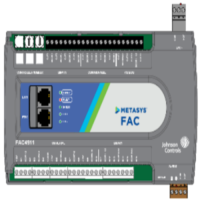
The Advanced Application Field Equipment Controller (FAC) Series Controllers are programmable controllers that can communicate using BACnet/IP, MS/TP, or N2 communications protocols, depending on the model. The FAC4911 is a BACnet Advanced Application Controller (B-AAC) that communicates using BACnet/IP communications protocol. All other FAC Series controllers can be switched between MS/TP and N2 communication protocols. FAC controllers used as MS/TP devices are B-AACs with integral RS-485 MS/TP communications
Model Number :
MS-FAC2513-0, MS-FAC2611-0, MS-FAC2612-1, MS-FAC2612-2, MS-FAC3611-0, MS-FAC3613-0, MS-FAC4911-0.

BỘ ĐIỀU KHIỂN DDC FEC   – JOHNSON CONTROLS

BỘ ĐIỀU KHIỂN DDC FEC – JOHNSON CONTROLS

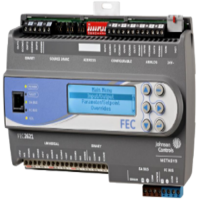
The Field Equipment Controller (FEC) Series products are programmable controllers that can
be switched between BACnet MS/TP and N2 communications protocols. When they are used as BACnet MS/TP devices, they are BACnet Application Specific Controllers (B-ASCs) with integral MS/TP communications. In N2 mode, they can be used to modernize sites with legacy Johnson Controls
Model Number: MS-FEC1611-1, MS-FEC1621-1, MS-FEC2511-0, MS-FEC2611-0, MS-FEC2621-0

BỘ ĐIỀU KHIỂN DDC EASY IO CW / FW  – JOHNSON CONTROLS

BỘ ĐIỀU KHIỂN DDC EASY IO CW / FW – JOHNSON CONTROLS

The CW (Wi-Fi) Controller Series is based on the very latest standards for IT networks and security and works with Wi-Fi b/g/ n. These controllers can be used as part of an existing building automation system or as a standalone WLAN GA network. The integrated Ethernet switch can be used for Daisy Chain wiring within recommended IT guidelines. Standard protocols such as BACnet, Modbus, MQTT, and SOX are supported. The CW Series includes an SQL database and RESTful API for additional data integration and multi-system interoperability. HTML5 dashboard, a suite of applications, kits and multi- functional adapter 
widgets are also integrated.
Model Number :
EasyIO-FW-28, EasyIO-FW-14, EasyIO-FW-08, CW-0404, CW-0806, CW-1612

BỘ ĐIỀU KHIỂN DDC PCG / PCA  – JOHNSON CONTROLS

BỘ ĐIỀU KHIỂN DDC PCG / PCA – JOHNSON CONTROLS

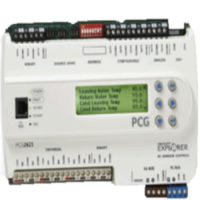
The FX-PC Family Controllers and network sensors communicate using the standard BACnet protocol. The BACnet protocol is a standard for ANSI, ASHRAE, and the International Standards Organization (ISO) for building controls. PCG and PCV devices are BTL-listed as BACnet Application Specific Controllers (B-ASCs). 
The PCA controllers are BTL- listed as BACnet Advanced Application Controllers (B-
AACs). The NS Series Sensors are BTL-listed as BACnet Smart Sensors (B-SSs).
Model Number :
CH-PCA2513-0, FX-PCA2611-0, FX-PCA2612-1, FX-PCA2612-2, FX-PCA3613-0, FX-PCA4911-0, FX-PCG1611-1, FX-PCG1621-1, FX-PCG2611-0, FX-PCG2621-0

BỘ ĐIỀU KHIỂN DDC CGE / CGM  – JOHNSON CONTROLS

BỘ ĐIỀU KHIỂN DDC CGE / CGM – JOHNSON CONTROLS

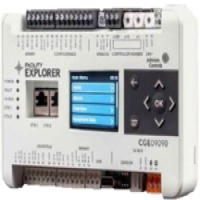
The CG series general purpose application controllers are well-suited for controlling a wide variety of facility and HVAC equipment, including fan coils, air handling units, packaged HVAC equipment, and central plant equipment. CG series controllers run pre-engineered and user-programmed Applications
F4-CGM models: BACnet MS/TP; N2. Zigbee wireless also supported (at FC Bus and for Sensors) with additional hardware. F4-CGE models: BACnet/IP
Model Number :
F4-CGM09090-0 , F4-CGM04060-0, F4-CGE09090-0 , F4-CGE04060-0 , F4-CGM09090-0H, F4-CGE09090-0H
 

Zalo