Tầng 8, Tòa nhà Sannam, số 78 Phố Duy Tân, P.Dịch Vọng Hậu, Q. Cầu Giấy, Tp. Hà Nội, Việt Nam

Advisory
Direct: 0904565626
Advisory
Direct: 0904565626

A comprehensive guide on how to choose appropriate fire alarm terminal and sensor equipment based on environmental conditions, fire risks, system compatibility, and specific facility requirements.
An effective fire alarm system relies not only on the central control panel but also on the accurate detection and prompt signal transmission of field devices. Therefore, choosing the right fire alarm terminal equipment must be based on building characteristics, fire risks, installation environments, and compatibility with the entire system.
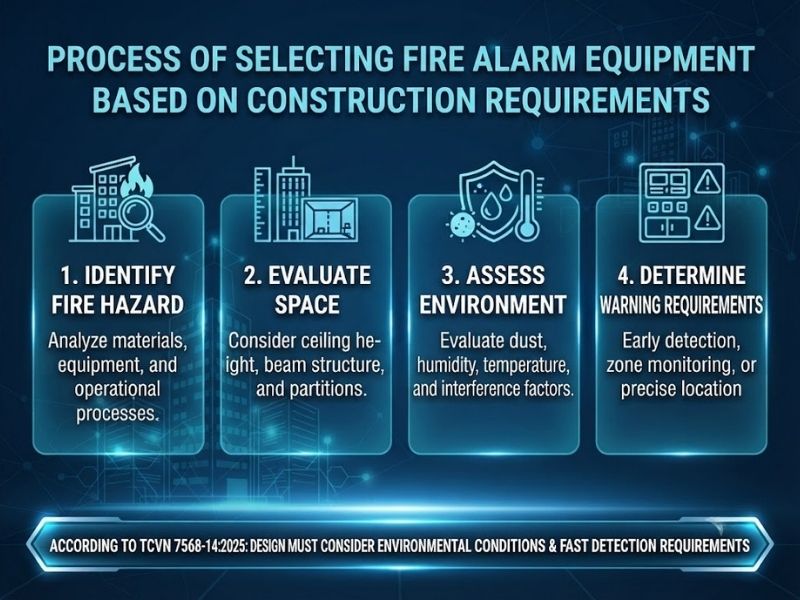
Before selecting fire alarm terminal devices, clearly define the characteristics of the protected area and design objectives to avoid using a single device type for every location.
- Identify fire risks: Examine the types of materials, equipment, and operational processes in each zone to determine which fire phenomenon is most likely to appear first, such as smoke, heat, or flames.
- Evaluate ceiling height and spatial structure: Ceiling height, beams, partitions, and interior layouts can affect detection capabilities and detector placement.
- Review environmental conditions: Dust, steam, smoke from normal operations, or temperature fluctuations can increase false alarm risks if unsuitable devices are selected.
- Determine notification requirements: Buildings may require early detection, zone-based monitoring, or precise device identification, guiding the choice of corresponding system architecture and device types. According to TCVN 7568-14:2025, fire alarm system design must account for environmental conditions, building types, rapid detection requirements, and system anti-interference capabilities.
Not all fire detection devices react the same way, as each type is designed to recognize a characteristic phenomenon of a fire.
Suitable for areas where smoke is an early indicator of fire. When choosing, consider sensitivity and expected smoke types, especially in environments prone to dust or vapor that can trigger false alarms. TCVN 7568-14:2025 also requires selecting smoke detector sensitivity tailored to various types of smoke.
Ideal for areas where a fire tends to generate distinct heat or where environmental conditions make smoke detectors unsuitable. For heat detectors, the activation threshold must be evaluated against actual ambient temperatures to prevent false alarms or delayed detection.
Considered in areas with a potential for rapid flame development or specific fire detection requirements. The sensitivity and spectral characteristics of the detector must align with the types of flames likely to occur in the protected zone.
Combine multiple fire phenomena within a single device to improve differentiation of fire conditions and minimize unwanted alarms. Depending on the environment, combining detection methods can be explored when a single characteristic fire phenomenon cannot be definitively identified.
After selecting the appropriate detector type, technical parameters must be verified to ensure the devices meet system requirements.
Devices must feature a sensitivity level aligned with the detection objectives and actual site conditions. Excessive sensitivity can increase unwanted alarms, while mismatched sensitivity can compromise early detection performance.
Review protection area, ceiling height and structure, and physical obstructions before determining device quantities and placement. Standards also mandate that detector placement accounts for ceiling height, structural design, furniture, and space utilization characteristics.
For areas subject to dust, high humidity, temperature swings, or potential false alarm triggers, select devices specifically engineered for those environments rather than relying solely on standard conditions.
Fire systems must feature the capability to identify and process abnormal states in devices or transmission lines. TCVN 7568-14:2025 also sets requirements for anti-interference performance and system operational continuity during faults.
>>> Learn more: Fire Alarm Field Device
.jpg)
A fire alarm terminal device only achieves full effectiveness when compatible with the control panel, wiring infrastructure, and associated components within the system.
- Determine system type: Check whether the facility uses a conventional or addressable fire alarm system to select correct equipment.
- Verify communication: For addressable systems, devices must match the manufacturer's communication protocol and control panel; never assume all addressable devices are universally interchangeable.
- Check power and transmission lines: Cross-reference voltage levels, wiring topologies, device counts per loop/zone, and line monitoring requirements.
- Ensure identification capability: In addressable systems, each device must be uniquely identifiable to pinpoint exact event locations and statuses.
- Verify device compatibility: Devices drawing power or signals loops from the control panel must be selected to match that specific control unit.
Fire alarm equipment selection for buildings should be tailored to specific zone characteristics rather than applying a uniform configuration across the entire facility.
- Offices: Prioritize detection solutions suited for workspaces, minimizing false alarms caused by HVAC systems, dust, or routine activities.
- Hotels and Apartments: Address bedrooms, corridors, public areas, and technical spaces, each presenting distinct environmental profiles.
- Server Rooms and Technical Areas: Select devices based on temperature profiles, electromechanical equipment, and factors that could influence detection performance.
- Manufacturing Plants: Evaluate materials, production workflows, dust levels, heat output, and fire growth rates to choose suitable detection methods.
- Warehouses: Account for storage heights, roof structures, and material characteristics when designing detector placement, quantity, and types. Location and spacing requirements must be derived from spatial geometry and risk profiles.
.jpg)
Certain choices that appear to save initial capital can compromise the reliability of the entire system during operation.
- Choosing equipment based solely on price: Low costs do not guarantee that a device fits the environment and detection requirements of the facility.
- Using a single detector type everywhere: Every zone has unique fire risks and environmental conditions, requiring choices based on real-world traits.
- Ignoring false alarm risks: Failing to evaluate dust, steam, temperature fluctuations, or environmental variables can cause unwanted system alerts.
- Neglecting compatibility checks: Incompatible devices with control panels or transmission links can cause the system to fail in recognizing or operating equipment correctly.
- Focusing only on devices while ignoring placement: Even high-spec equipment loses effectiveness if positioned incorrectly or physically obstructed. NFPA 72 also emphasizes that the selection and placement of fire-initiation devices must minimize unwanted alarms.
To ensure long-term system stability, equipment selection should be integrated directly into project design, installation, and actual operations.
Pre-installation site survey: Gather data on layouts, utility functions, ceiling heights, environments, and fire risks for every area.
Equipment synchronization: Prioritize configurations with clear compatibility among detectors, modules, control panels, and related terminal devices.
Plan for future expansion: For facilities anticipating expansion, provision the capacity of control panels, loops, or zones to prevent major overhauls later.
Pre-commissioning testing: Perform tests on every individual device, transmission line, and notification function to verify signals transmit accurately to the central panel.
Establish a maintenance plan: Periodically inspect equipment status, clean detectors, and evaluate response performance to sustain system reliability.
Selecting the right fire alarm terminal devices requires basing decisions on fire risks, environmental conditions, detection requirements, and system-wide compatibility rather than specs or price alone. When fire sensors are chosen and positioned appropriately, systems enhance early detection capabilities, reduce unwanted alarms, and support stable operations. For expert consultation on fire detection devices or building fire alarm solutions, Tri Viet Controls can assist in selecting configurations suited to the technical requirements and scale of your project.








Please leave your information, we will contact you to complete the order!