Tầng 8, Tòa nhà Sannam, số 78 Phố Duy Tân, P.Dịch Vọng Hậu, Q. Cầu Giấy, Tp. Hà Nội, Việt Nam

Advisory
Direct: 0904565626
Advisory
Direct: 0904565626
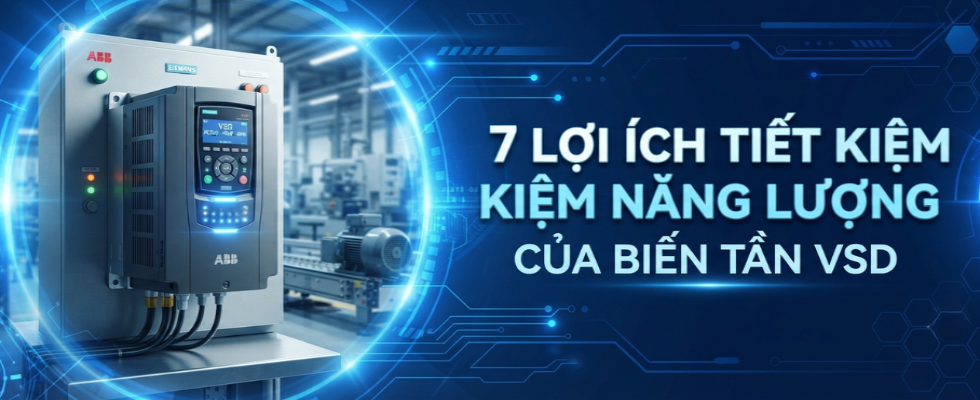
VSD drives save energy, lower power consumption, and optimize motor operation in HVAC, pump, and fan systems.
VSD inverter is not only used to control motor speed but also plays an important role in optimizing energy consumption. By adjusting motor speed according to the actual load demand, a system can reduce excess power consumption, lower operating costs, and improve energy efficiency. This is why VSD inverters are commonly considered for pump, fan, and HVAC systems with variable loads.
Motor energy consumption depends on factors such as motor power, speed, load characteristics, and operating time. In practice, many systems do not always need to operate at maximum capacity, but motors may still have to run at a fixed speed when no suitable control solution is available.
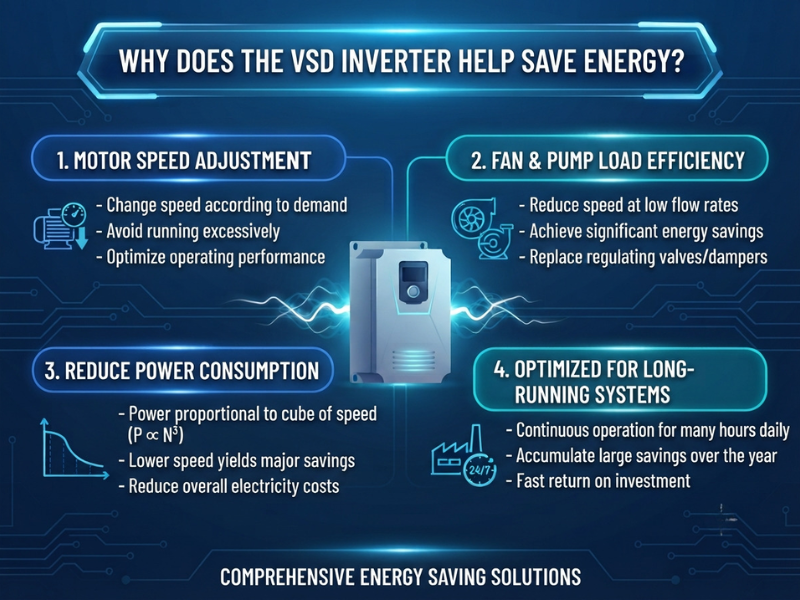
A VSD inverter allows motor speed to be adjusted according to system requirements. For loads such as fans and pumps, reducing speed when flow demand decreases can provide significant energy savings compared with maintaining a high speed and using valves or dampers to restrict the flow.
This is particularly important in facilities where systems operate for many hours each day. When a large motor runs continuously, even a small reduction in energy consumption per hour can result in a significant difference in annual electricity costs.
>>> Learn more: details about the VSD inverter
The effectiveness of a VSD inverter is not limited to its ability to reduce motor speed. When properly selected and configured, the device also helps the system adjust power output more closely to actual demand, thereby reducing unnecessary energy consumption.
In many systems, load demand changes over time, while motors are designed and operated according to peak-load conditions. Without a speed control solution, a motor may continue operating at high speed even when the system only requires part of its capacity.
A VSD inverter addresses this issue by adjusting motor speed according to demand. When the load decreases, the speed can be reduced instead of being maintained at maximum capacity.
For example, a ventilation fan system may require high airflow during peak hours but lower airflow when fewer people are using the facility. If the fan continues running at a fixed speed, part of the energy consumed during low-load periods may be unnecessary.
With a VSD inverter, fan speed can be adjusted according to control signals or actual system conditions. As a result, motor power is used more closely in line with demand rather than being continuously maintained at a high level.
Pumps and fans are among the load types with clear potential for VSD inverter applications because flow demand is often variable. Water flow, air volume, or system pressure can change depending on operating conditions and time of day.
With a traditional approach, the motor may run at a fixed speed while flow is controlled using a valve or damper. In this situation, part of the energy supplied by the motor is generated first and then restricted at the output.
A VSD inverter takes a different approach: it adjusts motor speed to produce the required flow rate from the beginning.
For example, in a water pumping system with changing demand, instead of allowing the pump to continuously run at high speed and then throttling the flow with a valve, a VSD inverter can reduce pump speed when demand decreases. This control method helps limit the supply of power beyond actual requirements.
This is also why VSD inverters are often included in HVAC optimization solutions, where fans and pumps can be controlled according to changing building loads. Trí Việt Controls also focuses on energy-saving HVAC solutions using variable-speed control for fans and pumps under low-load conditions.
.png)
A technical system rarely operates at the same load level throughout the entire day. Demand can vary according to working hours, the number of occupants, ambient temperature, or production conditions.
If a motor only has two operating states—on and off—or always runs at a fixed speed, its ability to respond to changing demand is limited. In contrast, a VSD inverter provides multiple speed levels, allowing the system to respond more flexibly to load changes.
For example, an HVAC system in a building may not require the same capacity at the beginning of the morning as it does when occupancy is high. Similarly, a factory ventilation system may have different requirements across production shifts.
When motor speed is adjusted according to actual operating conditions, the system does not have to maintain high power output throughout the entire operating period. As a result, unnecessary energy consumption can be reduced.
The key point is that energy savings do not come simply from “installing a VSD inverter.” The actual benefit depends on whether the VSD is used effectively to adjust motor operation according to load.
In pump and fan systems, controlling flow with valves or dampers is a common method. However, if the motor continues running at high speed while the output is restricted, the system may consume more energy than necessary.
A VSD inverter allows motor speed to be adjusted according to the required flow rate. Instead of generating excessive power and then using mechanical equipment to restrict the output, the system can reduce power at the motor itself.
The concept can be illustrated simply:
High motor speed → High flow → Valve/damper restricts flow
compared with:
Adjusted motor speed → Flow matches actual demand
This difference is particularly important for systems that frequently operate at different flow rates.
However, it should not be assumed that every system replacing a valve or damper with a VSD inverter will achieve the same level of energy savings. Actual performance also depends on load characteristics, pump/fan curves, operating hours, and the degree of load variation.
Operating time is an important factor when evaluating the energy-saving potential of a VSD inverter.
A high-power motor operating only a few hours per day will have a very different energy consumption profile from a motor operating continuously for many hours. Therefore, for the same reduction in power consumption, a system with longer operating hours can achieve more significant cumulative energy savings.
The basic relationship can be illustrated as follows:
Energy consumption = Power × Operating time
When a VSD inverter reduces power consumption during low-load periods, the resulting energy savings accumulate over time.
For example, a pump or fan system operating every day in a building, factory, or shopping center can have many operating hours in which variable-speed control can provide benefits.
Therefore, when evaluating a VSD inverter investment, businesses should not focus only on the motor's rated power. They should also consider operating hours and the actual load profile.
HVAC is one of the system groups with a continuous need for capacity adjustment. Cooling, ventilation, and water circulation requirements change according to time, ambient temperature, and building occupancy.
In HVAC systems, VSD inverters can be used for various motor-driven equipment, including:
AHU fans and air-handling equipment.
Ventilation fans.
Chilled-water pumps.
Condenser-water pumps.
Other equipment with variable loads.
When cooling demand decreases, fan or pump speed can be reduced instead of allowing the equipment to continue operating at a high level. When the load increases, speed can be increased accordingly.
When combined with sensors and DDC/BMS systems, control can be based on parameters such as temperature, pressure, flow rate, or actual operating conditions. Trí Việt Controls also highlights the combination of variable-speed control for fans and pumps with DDC/BMS to adjust HVAC operation according to actual load.
This allows the VSD inverter to become more than a motor-speed control device. It can serve as part of an overall energy optimization solution for a building.
Energy savings are a technical benefit, but for businesses, the ultimate value is often reflected in operating costs.
When a VSD inverter reduces power consumption during low-load periods, total electricity consumption can decrease accordingly. If a system includes multiple high-power motors operating for long periods, the potential impact on electricity costs becomes increasingly important.
In addition to cost considerations, adjusting motor operation according to demand allows businesses to manage energy more proactively. Operating data from the VSD can be integrated into monitoring or BMS systems to track equipment status and evaluate system performance.
However, energy savings should not be determined using a fixed percentage for every project. Actual performance should be calculated based on motor power, load characteristics, operating hours, the existing control method, and system conditions.
.png)
Not every motor has the same energy-saving potential when a VSD inverter is installed. Actual effectiveness depends largely on load characteristics and how the system is currently controlled.
This is one of the main situations that should be considered. When load demand changes continuously, variable-speed control allows the motor to avoid maintaining a fixed power level throughout the entire operating period.
Pump, fan, and HVAC systems commonly have this characteristic.
The longer a motor operates, the greater its total electricity consumption. Therefore, systems that operate continuously or for many hours each day may provide a stronger basis for evaluating the investment potential of a VSD inverter.
Facilities that may be considered include:
Factories and manufacturing facilities.
Office buildings.
Shopping centers.
Hotels.
Water supply systems.
Large-capacity HVAC systems.
If a motor frequently operates at high speed while output flow is controlled using a valve or damper, businesses should assess whether variable-speed control could provide a more suitable operating method.
However, changing the control method should be evaluated based on equipment characteristics and process requirements. The presence of throttling alone should not be used to make a definitive conclusion about potential energy savings.
Energy savings are not a fixed figure that applies to every system. Before investing, businesses should evaluate load characteristics, operating time, and the existing control method together.
Motors driving pumps, fans, conveyors, or production machinery have different load characteristics. Loads that require frequent speed changes should be evaluated differently from loads that remain relatively constant.
Load characteristics determine how effectively speed adjustment can reduce energy consumption and provide a basis for selecting a suitable VSD inverter.
Operating data should be collected instead of relying solely on the motor's nameplate power rating.
Key information to evaluate includes:
Motor power.
Operating hours per day.
Operating days per year.
Average load level.
Low-load periods.
High-load periods.
These data help determine current energy consumption and estimate the potential savings after system modification.
Two systems using the same type of motor can achieve very different energy-saving results if their control methods are different.
Businesses should determine whether the system currently:
Operates at a fixed speed.
Controls flow using a valve.
Controls flow using a damper.
Starts and stops according to a cycle.
Operates based on sensor signals.
This information provides a basis for determining how significantly a VSD inverter can change the existing operating method.
Installing a VSD inverter without proper configuration can result in lower-than-expected performance. Minimum speed, maximum speed, acceleration and deceleration times, control signals, and protection parameters should be configured according to the characteristics of the motor and load.
For HVAC systems, combining a VSD inverter with sensors and BMS also requires appropriate control logic so that motor speed changes according to actual demand rather than simply following a fixed setpoint.
It should not be assumed that every motor needs a VSD inverter solely for energy-saving purposes.
A VSD inverter generally provides greater benefits when a system requires variable speed or experiences frequent load changes. Conversely, if a motor consistently operates at a relatively fixed load with little need for speed adjustment, the energy-saving potential may not be sufficient to deliver the expected return on investment.
Businesses should evaluate at least four groups of information:
Load characteristics: What type of load does the motor drive, and does the load vary?
Operating time: How many hours does the equipment operate each day?
Current control method: Does the system currently use valves, dampers, or other throttling methods?
Investment cost: What are the costs of the VSD, electrical cabinet, sensors, system modifications, and implementation?
Based on these factors, businesses can estimate potential energy savings, investment costs, and the expected payback period.
This approach is more practical than applying a fixed energy-saving percentage to every system.
.png)
In modern buildings, a VSD inverter should be considered part of an overall control and energy management solution rather than simply a device for adjusting motor speed. Depending on the characteristics of each facility, it can be implemented in several ways:
Office buildings, hotels, and shopping centers:
Use VSD inverters for HVAC fans and pumps to adjust speed according to actual load demand, reducing the need for equipment to continuously operate at high capacity when demand decreases.
Factories and manufacturing facilities:
VSD inverters can be applied to pumps, fans, and motors that require variable-speed operation. The selection and implementation should be based on the production process and operating requirements of each system.
Integration with sensors and BMS:
Sensors provide information such as temperature, pressure, flow rate, or other required parameters. BMS/DDC systems can process these signals and coordinate the VSD so that motor speed changes according to actual operating conditions.
Implementation model:
Motor → VSD Inverter → Sensors/Control Devices → DDC/BMS → Monitoring and Management
This configuration allows the VSD inverter to participate in an integrated control system rather than operate independently.
When selecting a solution, businesses should not rely solely on motor power. They should also consider load characteristics, installation location, existing control methods, measurement devices, and BMS integration capabilities to achieve appropriate operating efficiency.
A VSD inverter can support energy savings by adjusting motor speed according to actual demand, particularly in variable-load applications such as pumps, fans, and HVAC systems. Its seven key energy-saving benefits include reducing energy consumption at partial load, optimizing pump and fan power, limiting excess energy use, reducing losses from throttling, improving efficiency in long-hour operation, supporting HVAC optimization, and reducing electricity costs.
However, actual energy savings depend on load characteristics, operating hours, the existing control method, and system configuration. Therefore, before making an investment, businesses should analyze operating data and calculate the potential benefits for each motor or group of equipment.
Trí Việt Controls can provide consulting for VSD inverter solutions based on the load characteristics, HVAC systems, and energy management requirements of each facility, with a focus on achieving appropriate operating efficiency.




Please leave your information, we will contact you to complete the order!