Tầng 8, Tòa nhà Sannam, số 78 Phố Duy Tân, P.Dịch Vọng Hậu, Q. Cầu Giấy, Tp. Hà Nội, Việt Nam

Advisory
Direct: 0904565626
Advisory
Direct: 0904565626

Learn what an automatic fire alarm system is, its components, fire detection and alarm operating principles, system types, and key considerations for building installations.
An automatic fire alarm system detects signs of fire such as smoke, abnormal temperature changes, or flame radiation and transmits signals to a control panel for processing and alarm activation. These systems are widely used in buildings, hotels, factories, and other facilities that require continuous fire monitoring. So, what components make up an automatic fire alarm system, how does it operate, and what should be considered during deployment?
An automatic fire alarm system is a collection of devices designed to detect signs of fire, transmit signals, process information, and activate alarms according to a predefined configuration. A complete fire alarm system helps detect potential fire incidents early and provides information for an appropriate response.
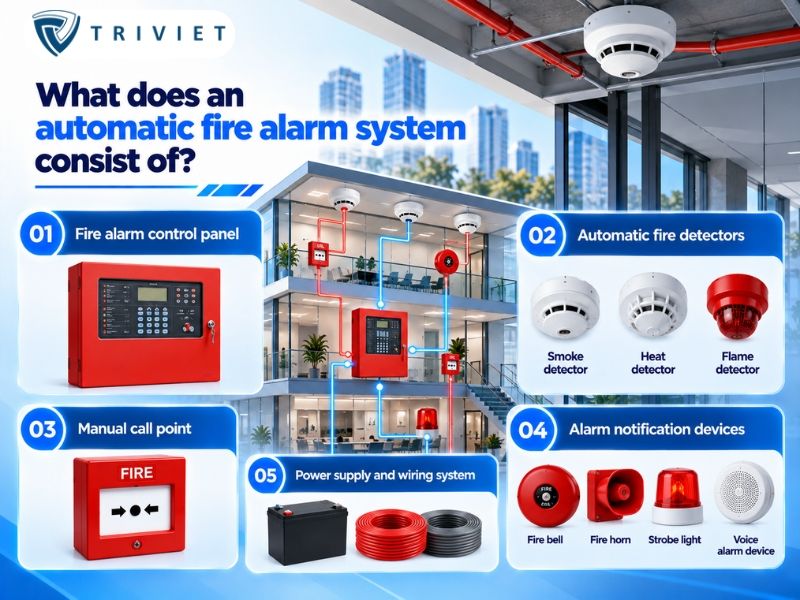
A fire alarm system typically includes a control panel, fire detection devices, manual call points, notification appliances, and a power supply system.
When a detector identifies signs of fire that meet its activation conditions, a signal is transmitted to the control panel. After processing the signal, the panel displays the fire alarm status and activates notification devices according to the configured logic.
It is important to distinguish a fire alarm system from a fire suppression system. Fire alarm equipment detects and reports incidents, while fire suppression systems perform functions to extinguish or control fires.
In some buildings, the two systems may be designed to operate together through interlocking functions. However, the control capabilities and scope of integration must comply with the approved technical design.
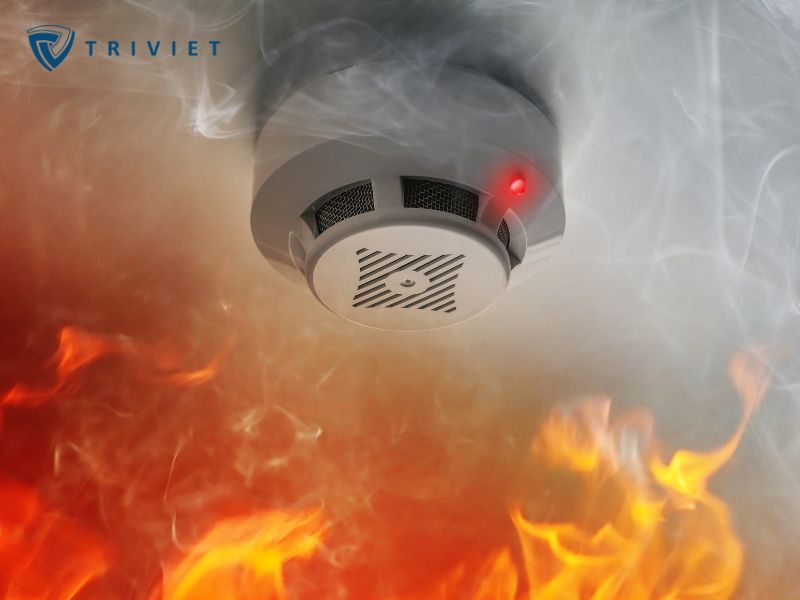
To detect and warn of fires, the devices within the system must work together through a unified architecture. Each component performs a specific function, from signal detection to processing and incident notification.
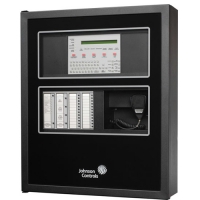
The Fire Alarm Control Panel (FACP) receives and processes signals from detectors, manual call points, and other connected input devices.
Its basic functions include:
Receiving fire alarm signals.
Monitoring the status of connected circuits or devices.
Displaying fire alarms and system faults.
Controlling alarm outputs according to the configuration.
Providing interlocking signals to related systems when specified in the design.
Depending on the architecture, the control panel may be part of a conventional or addressable fire alarm system.
A conventional fire alarm panel primarily identifies the zone where a signal originates, while an addressable fire alarm panel can identify individual devices through their configured addresses.
Control panel selection should be based on building scale, number of devices, zoning requirements, and expansion capabilities.
Fire detection devices directly monitor signs that may occur during a fire.
Depending on the design requirements, fire alarm field devices should be selected based on environmental conditions, fire risks, and compatibility with the system.
Common detector types include:
Smoke Detectors
Smoke detectors identify the presence of smoke particles within a monitored area according to their sensing principles and provide signals to the fire alarm system for processing.
These detectors are commonly used in spaces where smoke characteristics and environmental conditions are suitable for their operation.
Heat Detectors
Heat detectors identify temperature changes based on a predefined threshold or rate of temperature rise, depending on the device type.
Heat detectors may be selected for areas where smoke detectors are unsuitable due to environmental conditions.
Flame Detectors
Flame detectors use sensors to identify characteristic radiation emitted by flames, such as ultraviolet or infrared radiation, depending on the device.
These detectors are typically considered for areas with specific fire hazards that require an appropriate detection method.
Each detector type has its own operating principle and application range. Therefore, selection should be based on fire risks, spatial characteristics, and applicable design standards.
A manual call point is a device that allows people to manually initiate a fire alarm signal when they detect an incident.
When activated, the manual call point transmits a signal to the control panel for processing and alarm activation according to the system configuration.
This device complements automatic fire detectors, particularly when people identify dangerous conditions before the detectors reach their activation thresholds.
The locations and number of manual call points must be determined according to the design and applicable standards, ensuring accessibility when needed.
Notification devices alert building occupants when the system identifies a fire alarm condition.
Common devices include:
Fire alarm bells.
Fire alarm sounders.
Flashing warning lights.
Voice notification devices.
Depending on the building, notification devices may be arranged by area or zone to meet the incident notification strategy.
For voice notification systems, message content and coverage areas must be designed according to the building's emergency response and evacuation plan.
Power supplies and signal transmission lines are essential components for maintaining the operation of an automatic fire alarm system.
Typically, the system uses a primary power supply and a backup power source to ensure continued operation when the main supply fails.
The backup power source may use batteries with capacities calculated according to technical requirements.
In addition, the wiring system connects the control panel to detectors, manual call points, notification devices, and related modules.
Cable selection, wiring methods, and cable protection measures must comply with the design, circuit supervision requirements, and applicable standards.
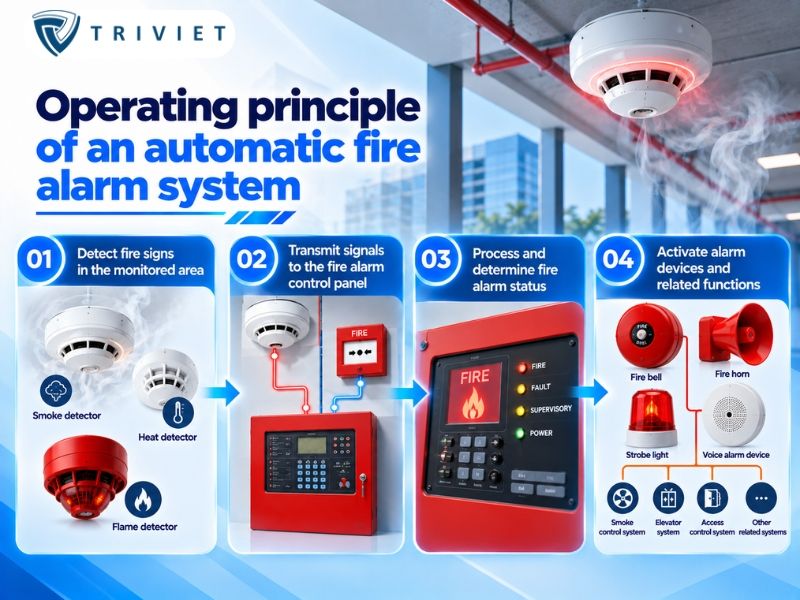
The operating principle of an automatic fire alarm system is based on detecting signs of fire, transmitting signals to the control panel, processing system status, and activating alarms.
Depending on the system type, signal transmission methods and the ability to identify the location of an incident may differ.
Under normal conditions, detectors continuously monitor parameters or phenomena within their detection capabilities.
When smoke, temperature, or flame radiation meets the activation conditions, the detector generates a fire alarm signal.
For example, in a corridor equipped with smoke detectors, when the smoke concentration reaches the detector's activation threshold, the device switches to the fire alarm state.
Detection capability depends on the detector type, installation location, environmental conditions, and fire development characteristics.
After a detector or manual call point is activated, the signal is transmitted to the fire alarm control panel through the designed circuit or communication line.
In conventional fire alarm systems, signals are typically managed by zone. The control panel can identify the zone where the alarm originates but may not identify the exact detector.
In addressable fire alarm systems, the control panel can identify devices through their configured addresses.
Signal transmission must be supervised to detect fault conditions such as broken wires or other abnormalities that the system is capable of identifying.
When receiving a signal, the fire alarm control panel processes it according to its operating principles and configured logic.
The process in which a fire alarm control panel processes signals includes receiving data from input devices, determining system status, and executing the configured alarm logic.
The panel may distinguish between conditions such as:
Fire alarm.
System fault.
Other supervisory conditions when supported.
When a fire alarm signal is confirmed, the panel displays relevant information for operators.
In conventional fire alarm systems, information is typically displayed by zone. In addressable systems, the panel may display the device address and location description.
Signal verification, delays, or conditional processing functions may only be applied when permitted and consistent with the design and relevant standards.
After identifying a fire alarm condition, the control panel activates notification devices according to the configuration.
Functions may include:
Activating fire alarm bells or sounders.
Activating warning lights.
Broadcasting voice announcements.
Sending signals to related technical systems.
Depending on the design, the fire alarm system may coordinate with smoke control systems, elevators, or access control systems through suitable interfaces and interlocking logic.
It is important to note that the fire alarm control panel does not automatically provide direct control over every related device. Interlocking functions must be designed, tested, and commissioned according to applicable requirements.
The basic operating sequence is:
Fire Detectors/Manual Call Points → Fire Alarm Control Panel → Notification Devices and Interlocking Outputs
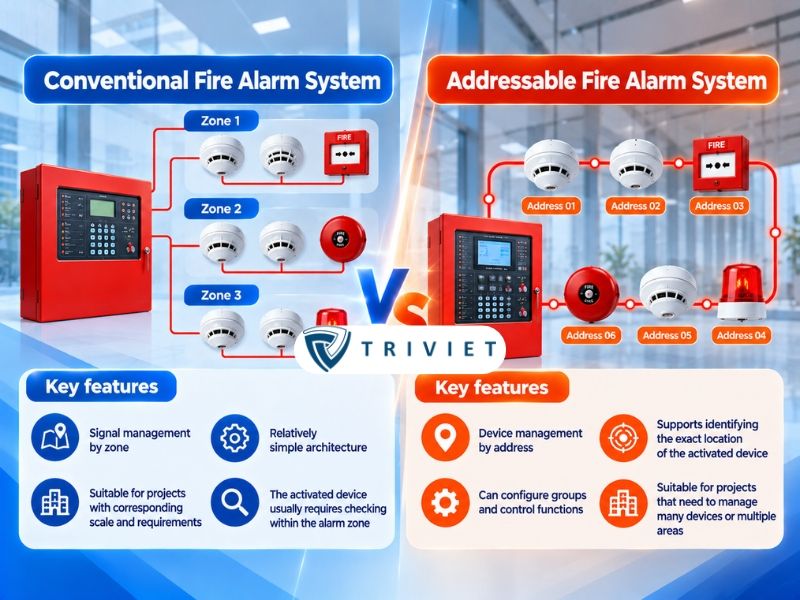
Automatic fire alarm systems are commonly classified according to how device signals are managed and identified. The two common architectures are conventional fire alarm systems and addressable fire alarm systems.
A conventional fire alarm system uses circuits or fire alarm zones to manage signals from connected devices.
When a detector within a zone is activated, the control panel displays the fire alarm status of the corresponding zone.
Key characteristics include:
Zone-based signal management.
Relatively simple architecture.
Suitability for buildings with corresponding scale and management requirements.
Identifying the exact activated device typically requires inspection within the alarm zone.
The number of zones and connected devices depends on the design and the limitations of the control panel and equipment used.
An addressable fire alarm system uses devices that can be individually identified through assigned system addresses.
When a device generates a signal, the control panel can display information associated with its configured address.
Key characteristics include:
Device management by address.
Support for identifying the location of the device generating a signal.
Configurable groups and control functions depending on system capabilities.
Suitability for buildings requiring management of numerous devices or multiple areas.
Connectivity capabilities and the number of devices on each loop depend on the control panel model, protocol, and modules used.
The two architectures mainly differ in signal management methods and device location identification capabilities.
| Criteria | Conventional Fire Alarm System | Addressable Fire Alarm System |
|---|---|---|
| Management method | By fire alarm zone | By device address |
| Incident location identification | Identifies the zone | Can identify individual devices |
| System configuration | Generally simpler | More flexible, depending on the platform |
| Device management | By circuit or zone | By device and loop |
| Application scope | Buildings of suitable scale | Buildings requiring detailed management |
Selection should not be based solely on whether a building is large or small. Design requirements, incident location identification capabilities, and applicable technical regulations must also be considered.
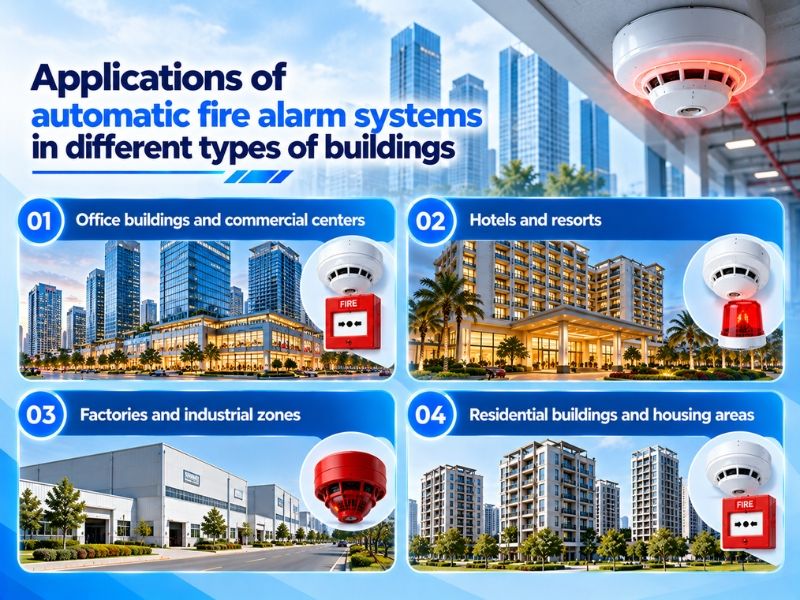
Automatic fire alarm systems are used in various types of buildings that require fire detection and warning capabilities. Deployment methods must suit the spatial characteristics, intended functions, and fire risks of each area.
In office buildings, fire alarm systems are designed to monitor protected areas such as workspaces, corridors, lobbies, and technical rooms.
When a fire alarm signal occurs, the control panel helps identify the area or device generating the alarm, depending on the system architecture.
For multi-story shopping centers with different functional areas, fire alarm zoning and notification device arrangements must align with the building's fire prevention and protection plan.
In hotels, early fire detection is particularly important because these facilities contain numerous accommodation areas and guest service spaces.
The system may include detectors, manual call points, fire alarm control panels, and notification devices arranged according to the design.
Depending on the scale and requirements, the fire alarm system may be integrated with voice notification systems or related technical systems to support emergency response and evacuation.
These functions must be designed in coordination with the building's fire safety strategy.
In factories, automatic fire alarm systems must be selected according to the characteristics of production areas, warehouses, and technical rooms.
Some environments may contain dust, steam, high temperatures, or other factors affecting detector performance.
Therefore, the same detector type should not be used for every area without evaluating fire risks and environmental conditions.
For areas with specific hazards, detection solutions may require specialized devices according to the approved design.
In apartment buildings, fire alarm systems may be installed in protected areas specified in the design, including corridors, common areas, basements, and technical spaces.
When signs of fire are detected, the system activates alarms and provides information to building management and operations personnel.
Depending on the building, fire alarm signals may be used to activate interlocking functions related to fire safety.
Equipment placement and operating logic must comply with the approved fire prevention and protection plan.
The effectiveness of a fire alarm system depends not only on equipment quality but also on appropriate selection, placement, and configuration. Both technical requirements and applicable standards must be considered during the design process.
Each detector type has different detection principles and operating conditions.
Factors to evaluate include:
Spatial characteristics.
Material types and fire risks.
Temperature and humidity conditions.
Presence of dust or steam.
Factors that may cause false alarms.
For example, in areas with frequent steam exposure, the use of smoke detectors should be carefully evaluated to minimize unwanted alarms.
Device types and installation locations must be determined according to the design and applicable standards.
Zone division or device address allocation affects the ability to identify where a signal originates.
For conventional fire alarm systems, the coverage of each zone and the number of devices must be determined according to technical limitations.
For addressable fire alarm systems, the number of devices per loop, power supply capacity, and zoning requirements must be checked.
Additionally, the number and spacing of detectors, manual call points, and notification devices must meet design requirements.
Device quantities should not be determined solely by total floor area while ignoring ceiling height, ceiling structure, spatial characteristics, and other conditions affecting fire detection.
In many buildings, automatic fire alarm systems need to exchange signals with other technical systems.
Before deployment, it is necessary to determine:
Signals that need to be exchanged.
Communication devices or modules.
Interlocking activation conditions.
Operating states during faults.
Functional testing procedures after installation.
Interlocking functions must be implemented through suitable interfaces and comply with the approved design.
In particular, control logic related to fire safety must not be modified without a complete evaluation of the technical requirements.
Fire alarm systems must have power supply arrangements that meet operating requirements under normal conditions and when the primary power source fails.
Design calculations should consider:
Power consumption of the control panel.
Current requirements of connected devices.
Power requirements of notification devices.
Required backup operating time.
Power fault monitoring capabilities.
Backup battery capacity must be determined according to actual loads and the operating duration required by applicable standards and design specifications.
Additionally, the system's ability to supervise communication lines and detect fault conditions must be verified.
The design and deployment of automatic fire alarm systems must comply with the regulations, standards, and legal requirements applicable to each building.
In Vietnam, TCVN 5738 is one of the technical standards related to automatic fire alarm systems. When applying this standard, it is necessary to verify the version in effect and relevant regulations at the time of design.
In addition to selecting suitable equipment, deployment must include the required inspection, testing, acceptance, and maintenance procedures.
For buildings subject to mandatory fire safety design appraisal and acceptance, technical documentation and solutions must meet the corresponding legal procedures.
Tri Viet Controls provides equipment categories for fire alarm systems and technical solutions for buildings, including fire alarm control panels and related devices within its product portfolio.
When selecting equipment, the following requirements should be clearly identified:
Building scale and intended functions.
Conventional or addressable fire alarm architecture.
Number of zones, loops, and devices.
Installation environment conditions.
Alarm and interlocking control requirements.
Scalability and maintenance capabilities.
Selecting compatible equipment that works together and meets design requirements helps minimize problems during system integration and operation.
For projects involving multiple technical systems, the scope of connectivity between the fire alarm control panel and related systems must be clearly defined to ensure that safety functions operate according to the approved design.
An automatic fire alarm system is an important component of a building's fire safety solution, responsible for detecting signs of fire, processing signals, and activating alarms. To ensure that the system meets actual requirements, it is essential to select appropriate equipment, design a suitable architecture, and comply with applicable technical standards.
Contact Tri Viet Controls for advice on automatic fire alarm equipment and system solutions tailored to your project's scale, building characteristics, and technical requirements.







Please leave your information, we will contact you to complete the order!