Tầng 8, Tòa nhà Sannam, số 78 Phố Duy Tân, P.Dịch Vọng Hậu, Q. Cầu Giấy, Tp. Hà Nội, Việt Nam

Advisory
Direct: 0904565626
Advisory
Direct: 0904565626

Where should HVAC sensors be installed? Learn how to select the right sensors for rooms, air ducts, AHUs, and piping systems to collect accurate and relevant data.
HVAC sensors provide data on temperature, humidity, CO₂, pressure, and other operating parameters, giving heating, ventilation, and air conditioning systems the information required for monitoring and control. However, measurement conditions vary depending on the installation location within a building. Therefore, selecting the right sensor type and positioning it correctly are essential to ensure that the collected data accurately reflects actual system conditions.
In an HVAC system, sensors are field devices responsible for measuring required parameters and transmitting data to controllers. This data can be used for monitoring or as input for control algorithms managing AHUs, FCUs, fans, valves, and other related equipment.
If an HVAC sensor is installed in an unsuitable location, its measurements may not accurately represent the actual conditions of the area or system being controlled. For example, a room temperature sensor installed near a heat source, supply airflow, or direct sunlight may record a temperature that differs from the representative temperature of the space.
Therefore, two factors should be identified during the design stage:
What parameter needs to be measured?
Where should that parameter be measured?
Only after these two factors have been determined should the sensor type, measurement range, output signal, and installation method be selected.
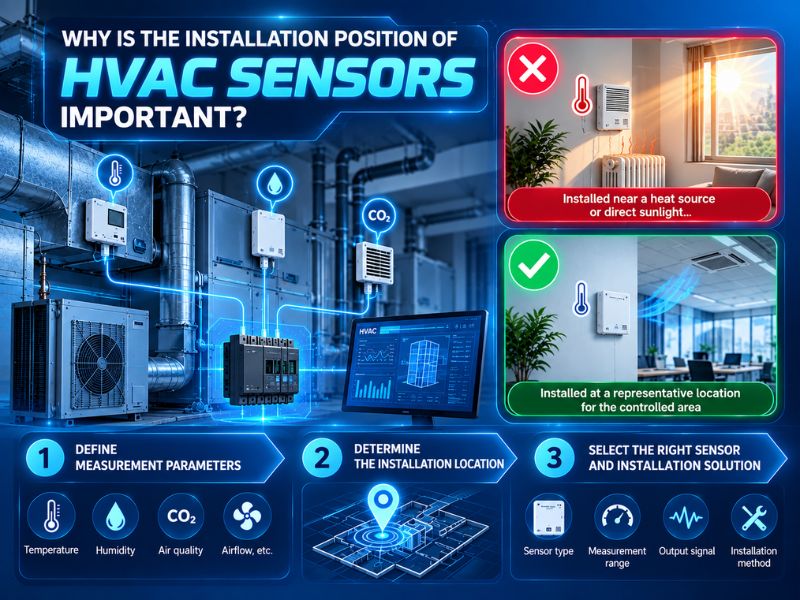
There is no single installation location suitable for every sensor. Depending on the monitoring and control requirements, HVAC sensors may be installed in rooms, air ducts, AHUs, or HVAC piping systems.
Room sensors are used to monitor environmental conditions in occupied spaces. Common parameters include temperature, relative humidity, and CO₂ concentration.
Temperature sensors provide data that allows the controller to determine the thermal conditions of a space and compare them with the setpoint. Humidity sensors are used when humidity control is also required, while CO₂ sensors can provide data for indoor air quality control and ventilation demand management.
For room sensors, locations that may cause localized measurement interference should be avoided, such as areas directly next to supply air outlets, near heat sources, or locations exposed to direct outdoor environmental effects.
The installation location should be selected to obtain measurements that are representative of the area being controlled.
Unlike room sensors, duct sensors are designed to directly measure parameters of the airflow inside the duct system.
Depending on the application, the system may use:
Duct temperature sensors.
Temperature and humidity sensors.
CO₂ sensors.
Pressure or differential pressure sensors.
The installation position should be determined based on the parameter being measured and the duct configuration. The sensor should have appropriate exposure to the airflow while avoiding locations where measurements may not accurately represent the condition being monitored.
One common application is measuring CO₂ in return air ducts or air ducts to provide data for a Demand Control Ventilation (DCV) strategy. As CO₂ concentration changes, the controller can use this data to adjust the amount of outdoor air according to the system configuration.
An AHU (Air Handling Unit) conditions and distributes air to multiple areas within a building. Therefore, an AHU may require several measurement points to monitor the air-handling process.
Depending on the AHU configuration, sensors may be installed to monitor:
Air temperature.
Humidity.
Pressure or differential pressure.
CO₂ or other air quality parameters when required.
Airflow conditions.
For example, temperature sensors can be installed at points where supply or process air temperature needs to be monitored, while differential pressure sensors can be used to monitor conditions related to air filters or system pressure.
Data from these sensors is transmitted to the controller for processing. Based on actual measurements and the control strategy, the system can control valves, dampers, fans, or other related equipment.
Because AHU configurations vary between projects, the number and location of sensors should be determined according to actual control requirements rather than applying a fixed configuration.
In addition to air systems, HVAC systems also include chilled-water or hot-water circuits that require monitoring. Sensors can be installed on piping to monitor the condition of the fluid.
Common devices include:
Temperature sensors: Monitor water temperature at required points in the system.
Pressure sensors: Measure pressure at specific points for operational monitoring.
Differential pressure sensors: Measure the pressure difference between two points in the system.
Flow sensors: Monitor the amount of water flowing through pipes or equipment.
This data can be transmitted to the DDC/BMS for monitoring and control of pumps, valves, and other related HVAC equipment.
.jpg)
Each facility has different measurement requirements. Therefore, the layout of HVAC sensors must be determined based on the location and monitoring objectives.
After determining the installation location, the next step is selecting a sensor with suitable technical specifications. Selection should not be based solely on the sensor name, as products designed to measure the same parameter may differ in measurement range, accuracy, output signal, and operating environment.
This is the first criterion when selecting an HVAC sensor. Depending on monitoring and control requirements, the system may need to measure:
Temperature, humidity, CO₂, pressure, differential pressure, and flow.
Some devices can measure multiple parameters simultaneously. For example, a wall-mounted sensor may combine CO₂, relative humidity, and temperature measurement, while certain duct sensor models can measure both temperature and humidity.
Even when measuring the same parameter, a temperature sensor designed for room applications may not necessarily be suitable for installation inside an air duct or on a pipe.
Sensors can be categorized according to installation location, including:
Room/wall-mounted sensors.
Duct sensors.
Pipe sensors.
Outdoor sensors.
Each type has a construction and installation method suited to its intended measurement environment. Therefore, the application specified by the manufacturer should be carefully checked before selecting a device.
The measurement range should cover the expected operating conditions of the system. However, a wider measurement range is not necessarily always better.
The following factors should be considered together:
Measurement range: Suitable for the actual operating range.
Accuracy: Meets the system's monitoring or control requirements.
Stability: Important for sensors operating continuously over long periods.
Requirements may also vary between measurement points. A sensor used directly for control may require different technical specifications from one used only for monitoring.
The sensor output signal must be compatible with the controller receiving the data. Depending on the equipment used in HVAC/BMS systems, common signal types may include:
0–10 V.
4–20 mA.
Passive resistive signals.
Other signals or protocols depending on the device configuration.
Before selecting a sensor, check the input types supported by the DDC or controller. If the sensor output and controller input are incompatible, the devices may not be able to connect directly or may require an additional signal conversion component.
(1).jpg)
In a Building Management System, HVAC sensors are among the primary data input sources used for monitoring and control.
The basic operating flow can be described as:
HVAC Sensor → DDC/Controller → Actuator → BMS
The HVAC sensor measures field parameters and sends signals to the DDC. The controller processes the data and compares it with setpoints or control logic to determine the appropriate action.
For example:
Temperature Sensor → DDC Receives the Value → Compares It With the Setpoint → Controls Valve/Fan → BMS Monitors System Status
The BMS can collect and display this data through its management interface, allowing operators to monitor system conditions.
As a result, sensors do not simply function as standalone measuring devices; they become an integral part of the HVAC automatic control loop.
Even when the correct sensor is selected, inappropriate placement or installation methods can still affect data quality. Some common mistakes to avoid include:
Installing sensors in the wrong location: A sensor that does not accurately represent the area or environment being measured may provide data that is unsuitable for the intended control purpose.
Installing sensors near sources of interference: Heat sources, direct airflow, or localized environmental conditions can affect measurement values.
Selecting an unsuitable measurement range: The sensor range should be checked against the expected operating range of the system.
Failing to check the output signal: The sensor output must be compatible with the input of the DDC or receiving device.
Ignoring electrical interference: When signal cables are installed in environments containing multiple electrical devices, system requirements for wiring and interference protection should be followed.
Failing to test after installation: After installation, measurement values, signals transmitted to the controller, and BMS display functionality should be checked to identify measurement deviations or connection errors.
During operation, sensors should also be inspected according to the system maintenance schedule. Trí Việt Controls includes the inspection of temperature, humidity, pressure, and flow sensors among the field-device checks performed during building automation system maintenance.
Installing HVAC sensors in appropriate locations enables the system to receive accurate data and adjust its output based on actual load.
Trí Việt Controls provides a range of sensors for HVAC and BMS applications, supporting the measurement of temperature, humidity, CO₂, and other technical parameters in buildings.
Some available product series include:
CD-3xx-E00-00 Series: Wall-mounted sensors/transmitters for measuring CO₂, relative humidity, and temperature in HVAC applications.
CD-Px000 Series: Duct-mounted transmitters for measuring CO₂ and temperature, suitable for applications such as Demand Control Ventilation, outdoor air management, and indoor air quality control.
HT-1300 Series: Duct-mounted sensors specifically designed to measure relative humidity and temperature in HVAC systems.
When selecting a device, it is important to consider the measured parameter, installation location, measurement range, accuracy, output signal, and compatibility with the existing controller.
Trí Việt Controls can provide consultation on selecting HVAC sensors according to the technical requirements and BMS configuration of each project, helping ensure that each device is suitable for its measurement location and actual monitoring and control requirements.
Contact Trí Việt Controls for consultation on HVAC sensors suitable for your system and project-specific technical requirements.








Please leave your information, we will contact you to complete the order!